Introduction
Most people try a plant‑based diet for familiar reasons—better health, weight loss, or a desire for intentional living. Yet the benefits often extend far beyond what they expect. Ongoing research reveals that even modest increases in whole plant foods don't just support your health; they can transform it in unexpected ways.
Let’s explore some of the most compelling “hidden wins” of a plant‑based lifestyle, supported by science and real‑world experience, to see the broader impact these dietary choices can have.
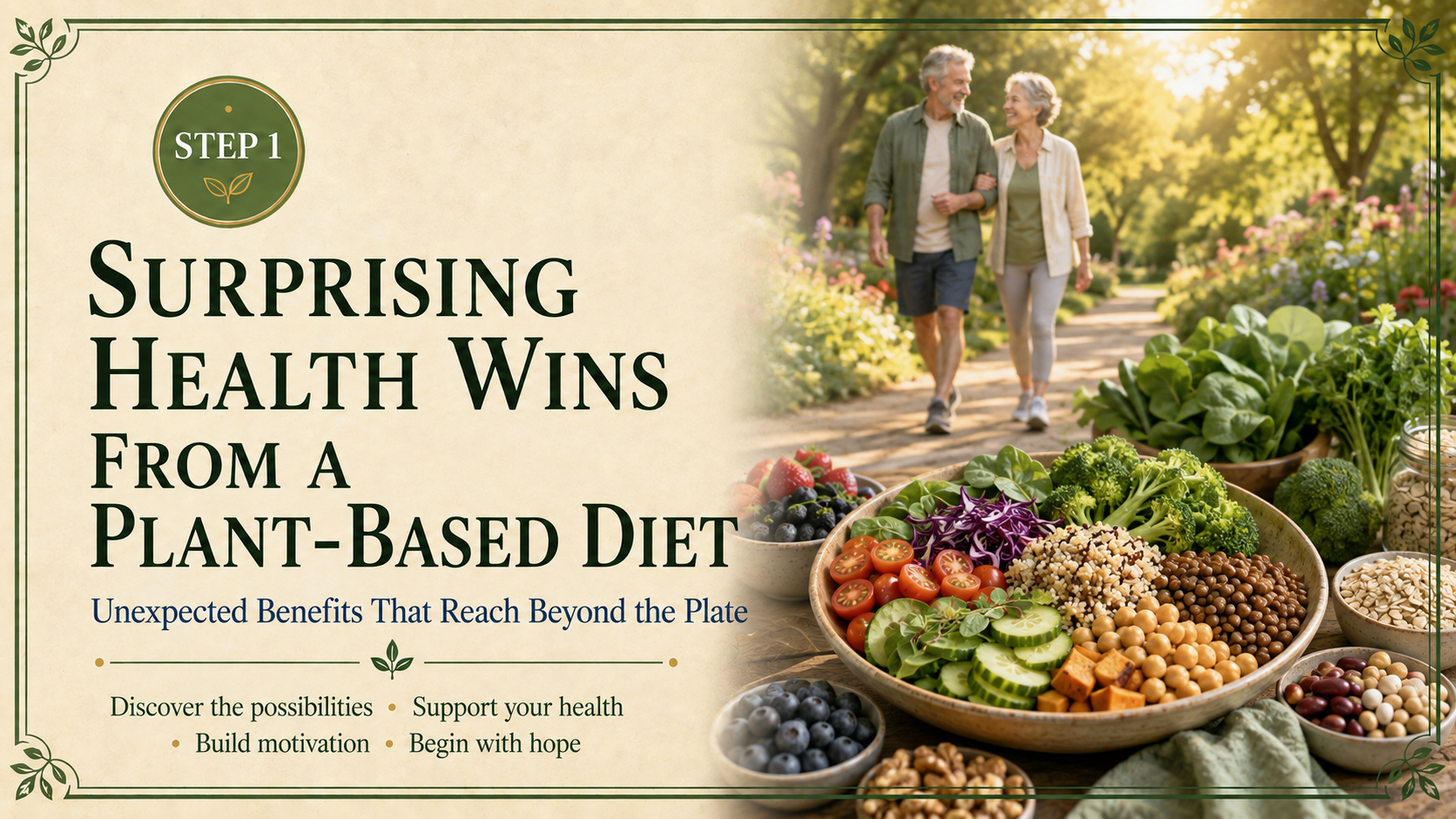
Surprising Health Wins from a Plant-Based Diet
1. Naturally Lower Blood Pressure
Studies show people who eat plant‑based foods tend to have lower blood pressure. Plant‑forward eating can also help reduce high blood pressure among those who need intervention. (Tomé-Carneiro & Visioli, 2023, pp. 127-150) Plants are naturally low in sodium and rich in potassium, fiber, and antioxidants, which work together to support healthier blood flow. (Tomé-Carneiro & Visioli, 2023)
2. A Lower Risk of Early Death
A large study of more than 70,000 people found vegetarians had a 12% lower risk of death compared with non‑vegetarians. Removing saturated fat and cholesterol from your diet improves heart health, enhances circulation, and reduces the risk of chronic disease. in Mood
3. Controlled Study
A controlled study found that participants who switched to a vegetarian diet reported significant mood improvements within two weeks. By increasing their intake of antioxidants and fiber and cutting out inflammatory foods, they supported their emotional well‑being.
4. Stronger Protection Against Heart Disease
One study, involving more than 44,000 people, discovered that vegetarians were 32% less likely to develop ischemic heart disease. By building your meals around whole foods, you give your heart the support it needs to thrive.
5. Reduced Cancer Risk
Studies from Loma Linda University suggest that plant‑based diets may provide protective benefits against several cancers. Especially among women, vegans showed the lowest overall cancer risk.
6. Lower Risk of Type 2 Diabetes
Plant‑based diets not only help stabilize blood sugar but also reduce inflammation and support a healthy weight—each a key factor in diabetes prevention. Although not a cure, following a plant-based diet is a powerful tool for lowering risk and improving long-term health.
7. Yes — You Can Build Muscle on Plants
A study in Sports Medicine found that young men gained the same amount of muscle whether they consumed soy protein (vegan) or whey protein (omnivore) during resistance training. (Davis et al., 2025, pp. 150-174) Protein quality matters, and plants meet the challenge. (Ferrari et al., 2022)
8. A Stronger Immune System
Vitamins, minerals, and antioxidants are packed into fruits, vegetables, legumes, and whole grains, helping your body defend itself. Many people notice fewer colds, faster recovery, and more consistent energy as a result.
9. Support for Arthritis and Inflammation
Research suggests that removing dairy and focusing on anti-inflammatory plant foods may reduce arthritis symptoms. For example, a vegan, gluten-free diet showed promising results in improving markers of rheumatoid arthritis.
10. More Energy — Naturally
After shifting to a plant‑based lifestyle, many people notice an increase in energy. Plant‑forward eating, according to professional athletes, is often credited with improved stamina and recovery.
11. Longer Life Expectancy
Several studies indicate that plant‑based eaters may live 3 to 6 years longer on average. (Ghorbani et al., 2023) Meals that reduce inflammation, support heart health, and nourish your cells make longevity a natural result. (Wang et al., 2023)
12. Less Body Odor and Better Breath
This one surprise people, but it’s real: cut out dairy and red meat, and you often notice fresher breath and reduced body odor. Plant-based eating also benefits your microbiome and digestion. (Sidhu et al., 2023)
Will Going on a Plant-Diet Make You Weak
Plant-based and vegan diets can make you stronger
Plant-based diets support muscle mass gain among young adults, according to a study published in Sports Medicine. Researchers compared protein intake and leg muscle mass in young men who followed either a vegan diet or an omnivorous diet as part of a twice-weekly resistance training program. Vegan participants took soy protein isolate supplements while nonvegan participants supplemented protein intake with whey (dairy) protein supplements. All participants increased muscle mass with no differences between the diet groups. These results suggest protein source does not affect muscle gain among young men with adequate protein intake. - via Physicians Committee for Responsible Medicine
Give Plant-based Diet a Try
Curious about living on a vegan diet? Commit to a plant-based approach for just one month and observe the difference in your energy and health firsthand. Make the switch and discover what a plant-based month can do for you!
Now is the time to act for your health
Take charge of your health today. Whether you're rebooting your diet or trying a plant-based lifestyle for the first time,
- The Plant-Based Solution: America’s Healthy Heart Doc’s Plan to Power Your Health
- The China Study Solution: The Simple Way to Lose Weight and Reverse Illness, Using a Whole-Food, Plant-Based Diet
- How Not to Die: Discover the Foods Scientifically Proven to Prevent and Reverse Disease
- The Forks Over Knives Plan: How to Transition to the Life-Saving, Whole-Food, Plant-Based Diet
Author's note
When I first explored a plant‑based lifestyle, better nutrition was my main expectation. I didn’t foresee the ripple effects on energy, mood, and long‑term health. Over time, I saw simple, whole foods quietly transform the body in surprising and deeply encouraging ways.
This article highlights some lesser-known wins: improvements that frequently appear before the scale moves or lab numbers change. My hope is that these insights help you notice victories beneath the surface and inspire nourishing choices, one day at a time.
— --Robert
Comments Invitation
Comment Invitation
I’d love to hear from you.
What stood out to you in this post? What questions or experiences would you add?
Share your thoughts below — your voice helps others on their journey too.
Reference List
Tomé-Carneiro, J. & Visioli, F. (2023). Plant-Based Diets Reduce Blood Pressure: A Systematic Review of Recent Evidence. Current Hypertension Reports 25(7), pp. 127-150. https://doi.org/10.1007/s11906-023-01243-7
Tomé-Carneiro, J. & Visioli, F. (2023). Plant-Based Diets Reduce Blood Pressure: A Systematic Review of Recent Evidence. Current Hypertension Reports 25. https://doi.org/10.1007/s11906-023-01243-7
Beezhold, B. L. & Johnston, C. S. (2012). Restriction of meat, fish, and poultry in omnivores improves mood: A pilot randomized controlled trial. Nutrition Journal 11. https://doi.org/10.1186/1475-2891-11-9
(2021). Dietary patterns and biomarkers of oxidative stress and inflammation: A systematic review of observational and intervention studies. Redox Biology 42. https://doi.org/10.1016/j.redox.2021.101869
Dybvik, J. S., Svendsen, M. & Aune, D. (2023). Vegetarian and vegan diets and the risk of cardiovascular disease, ischemic heart disease, and stroke: a systematic review and meta-analysis of prospective cohort studies. European Journal of Nutrition 62. https://doi.org/10.1007/s00394-022-02942-8
(April 1, 2023). Heart Health Through Whole Foods. University Hospitals. https://www.uhhospitals.org/-/media/files/services/heart-and-vascular/car-00467-wholefoods-fact-sheet-final.pdf
Orlich, M. J., Singh, P. N., Sabaté, J., Fan, J., Sveen, L., Bennett, H., Knutsen, S. F., Beeson, W. L., Jaceldo-Siegl, K., Butler, T. L., Herring, R. P. & Fraser, G. E. (2015). Vegetarian Dietary Patterns and the Risk of Colorectal Cancers. JAMA Internal Medicine 175(5). https://doi.org/10.1001/jamainternmed.2015.59
Schlesinger, S. (2023). Diet and Diabetes Prevention: Is a Plant-Based Diet the Solution?. Diabetes Care 46(1), pp. 6-8. https://doi.org/10.2337/dci22-0041
Schorr, K. A., Agayn, V., Groot, L. C., Slagboom, P. E. & Beekman, M. (2024). A plant-based diet index to study the relation between diet and disease risk among adults: a narrative review. Journal of Nutritional Health & Aging 28(6). https://doi.org/10.1016/j.jnha.2024.100272
Davis, B. E., Young, I., Giglotti, J. C., Yao, J., & Tou, J. C. (2025). The Impact of Whey and Soy Protein Supplementation on Resistance Training in Young Adults: A Systematic Review and Meta-Analysis. Journal of Dietary Supplements 23(1), pp. 150-174. https://doi.org/10.1080/19390211.2025.2604679
Ferrari, L., Panaite, S., Bertazzo, A. & Visioli, F. (2022). Animal- and Plant-Based Protein Sources: A Scoping Review of Human Health Outcomes and Environmental Impact. Nutrients 14(23). https://doi.org/10.3390/nu14235115
(2023). The best foods for vitamins and minerals. Harvard Health Publishing. https://www.health.harvard.edu/staying-healthy/the-best-foods-for-vitamins-and-minerals
Khalid, W., Arshad, M. S., Ranjha, M. & Różańska, M. B. (2022). Functional constituents of plant-based foods boost immunity against acute and chronic disorders. Open Life Sciences 17(1), pp. 1075-1093. https://doi.org/10.1515/biol-2022-0104
Hafström, I., Ringertz, B., Spångberg, A., Zweigbergk, L. v., Brannemark, S., Nylander, I., Rönnelid, J., Laasonen, L. & Klareskog, L. (2001). A gluten-free vegan diet improves signs and symptoms of rheumatoid arthritis: effects on arthritis correlate with reduced antibodies to food antigens. Rheumatology 40(10), pp. 1175-1179. https://doi.org/10.1093/rheumatology/40.10.1175
Damasceno, Y. O., Leitão, C. V., Oliveira, G. M., Andrade, F. A., Pereira, A. B., Viza, R. S., Correia, R. C., Campos, H. O., Drummond, L. R. & Leite, L. H. (2024). Plant-based diets benefit aerobic performance and do not compromise strength/power performance: a systematic review and meta-analysis. British Journal of Nutrition 131(5), pp. 829-840. https://doi.org/10.1017/S0007114523002258
Ghorbani, Z., Kazemi, A., Shoaibinobarian, N., Taylor, K. & Noormohammadi, M. (2023). Overall, plant-based, or animal-based low-carbohydrate diets and all-cause and cause-specific mortality: A systematic review and dose-response meta-analysis of prospective cohort studies. Aging Research Reviews 90. https://doi.org/10.1016/j.arr.2023.101997
Wang, Y. B., Page, A. J. & Gill, T. K. (2023). The association between diet quality, plant-based diets, systemic inflammation, and mortality risk: findings from NHANES. European Journal of Nutrition 62. https://doi.org/10.1007/s00394-023-03191-z
Sidhu, S. R., Kok, C. W., Kunasegaran, T. & Ramadas, A. (2023). Effect of Plant-Based Diets on Gut Microbiota: A Systematic Review of Interventional Studies. Nutrients 15(6). https://doi.org/10.3390/nu15061510
Disclaimer
The information on this website is for educational purposes only and is not a substitute for professional medical advice, diagnosis, or treatment. Always consult with a qualified healthcare provider before making changes to your diet, lifestyle, or health routine, especially if you have existing medical conditions or take prescription medications.
Interesting. I’m not a vegan myself, but I’ve quite a few people who were. But my thing is, if it’s so wonderful, then why do people change to regular diet? I’m not saying it’s bad, but for all of the push for it….I know of a few who went back to regular food….and I know a couple of people I grew up with who have gone vegan for an amount of time, then go back to regular, then back to being a vegan. That seems to me, to be defeating the whole purpose of being a vegan/vegetarian. :/ Or is that a suggested thing to do? I honestly don’t know too much about it, so these aren’t meant to offend anyone….I thought it was supposed to be a lifestyle change. And I do love veggies and fruits….our family goes to the farmers’ market weekly and stock up for the week.