Introduction
Choosing the right plant‑based milk can feel confusing — but it doesn’t have to be.
This guide compares oat, almond, and soy milks for nutrition, sustainability, and taste, helping you choose with confidence.
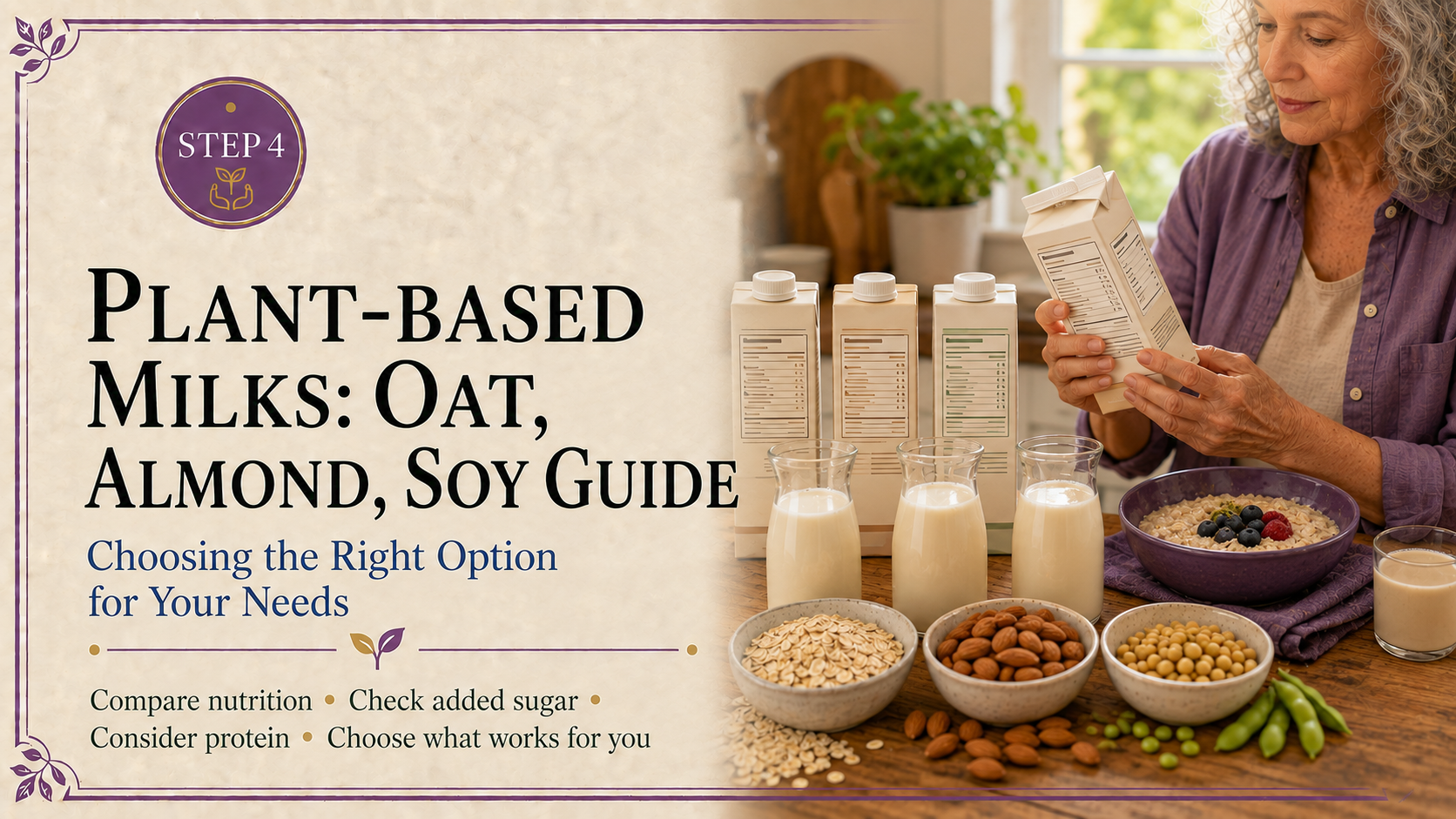
Plant-based milks: oat, almond, soy guide
A Clear, Evidence‑Based Guide to Choosing What’s Best for Your Health
Plant-based milks have exploded in popularity for good reason. They’re versatile, often fortified, and support a more sustainable, plant-forward lifestyle. But not all plant milks are equal. Their nutrition, environmental impact, and taste vary widely.
Now, let’s explore how these popular plant-based milks compare, starting with oat milk.
Oat Milk
Creamy, comforting, and widely available, oat milk has become a favorite for coffee lovers and home cooks alike.
Pros
- Naturally creamy texture
- Mild, neutral flavor
- Often fortified with calcium, vitamin D, and B12.
- More sustainable than almond milk (lower water use)
- Excellent for lattes, smoothies, and baking
Cons
- Low in protein (usually <1 g per 100 g) (PharmD, 2026)
- Higher in carbohydrates
- Some brands add oils, gums, or sweeteners.
Brand Notes
- Oatly: Well-known for barista blends with good foaming ability, ideal for coffee; Califia Farms: Also offers barista-style options for lattes and coffee drinks.
- Check store-brand labels for fortification; some may be less fortified than major brands.
Almond Milk
Light, refreshing, and low in calories, almond milk is a long-time staple in the plant-based world.
Pros
- Very low-calorie
- Mild, versatile flavor
- Often fortified with calcium and vitamin D
- Great for smoothies, cereal, and light cooking
Cons
- Ver (Milk and Plant-Based Milk Alternatives: Know the Nutrient Difference, 2023)y low protein.
- Almond farming is water‑intensive
- Many brands add stabilizers or sweeteners.
Brand Notes
- Silk Unsweetened Almond: Consistent taste and texture; widely available in most stores.
- Three Trees: Minimal-ingredient choice; considered cleaner than most brands.
Soy Milk
Nutritionally, soy milk stands closest to dairy, and research consistently supports its benefits. (Erlich et al., 2024)
Pros
- Highest protein of the three (≈3.5 g per 100 g)
- Complete protein with all essential amino acids
- Typically fortified with calcium, vitamin D, and B12.
- Contains beneficial isoflavones
- Recognized by U.S. dietary guidelines as nutritionally comparable to dairy
Cons
- Slight “bean” flavor (varies by brand)
- Some people avoid soy due to misconceptions, but research shows typical consumption is safe. (Messina et al., 2022, pp. 5824-5885)
- Not suitable for those with soy allergies
Brand Notes
- Silk Soy, WestSoy, EdenSoy: Top protein content and cleaner ingredient lists than many brands.
- Look for barista blends if you want soy milk that foams well for specialty drinks and coffee.
Nutritional Snapshot (Per 100 g)
(Values vary by brand; these are representative averages.)
Milk Type | Calories | Protein | Fat | Carbs | Calcium | Vitamin D |
Oat | 48 | 0.8 g | 2.75 g | 5.1 g | 148 mg | 68 IU |
Almond | 19 | 0.66 g | 1.56 g | 0.67 g | 158 mg | 63.6 IU |
Soy | 38 | 3.55 g | 2.12 g | 1.29 g | 101 mg | 27.2 IU |
Environmental Considerations
With nutrition and sustainability reviewed, you may be wondering: which is right for you?
If your goal is overall nutrition, protein quality, and the closest match to dairy, the research is detailed:
Soy milk is the best all‑around choice.
It offers the most complete nutrition, the highest protein, and strong fortification — making it ideal for daily use.
If your goal is sustainability or creaminess, oat milk is an excellent second choice.
Almond milk works well for those seeking very low calories, but nutritionally, it is the least robust unless heavily fortified.
Final Thoughts
Understanding each option’s strengths and limitations helps you choose the plant-based milk that best supports your health, values, and lifestyle.
Whether you’re pouring it into coffee, blending it into a smoothie, or using it in your cooking, the right plant milk can be a simple, nourishing part of your daily routine.
Author’s Note
As someone who values both nourishment and simplicity, I’ve watched the rise of plant‑based milks with genuine curiosity. My goal here isn’t to promote one brand or trend, but to help you understand what’s inside the carton — and how those choices affect your health and the planet.
Each of us has unique needs and values; this comparison is meant to empower you to choose what aligns best with yours.
— Robert
Continue The Conversation
Every wellness journey is unique, and we can learn a great deal from one another's experiences.
What stood out to you in this article?
Have you faced similar challenges, discovered helpful strategies, or gained insights of your own?
I invite you to share your thoughts in the comments below. Your experience may encourage someone else who is taking the next step on their own journey.
Remember, meaningful change often begins with a single step—and none of us has to walk the path alone.
Reference List
PharmD, J. C. (2026). Which milk is best? Almond, hemp, oat, soy, or cow's milk. Medical News Today. https://www.medicalnewstoday.com/articles/325425
(2023). Milk and Plant-Based Milk Alternatives: Know the Nutrient Difference. U.S. Food and Drug Administration. https://www.fda.gov/consumers/consumer-updates/milk-and-plant-based-milk-alternatives-know-nutrient-difference
Erlich, M. N., Ghidanac, D., Mejia, S. B., Khan, T. A., Chiavaroli, L., Zurbau, A., Ayoub-Charette, S., Almneni, A., Messina, M., Leiter, L. A., Bazinet, R. P., Jenkins, D. J., Kendall, C. W., & Sievenpiper, J. L. (2024). A systematic review and meta-analysis of randomized trials of substituting soymilk for cow’s milk and intermediate cardiometabolic outcomes: understanding the impact of dairy alternatives in the transition to plant-based diets on cardiometabolic health. BMC Medicine 22. https://doi.org/10.1186/s12916-024-03524-7
Messina, M., Mejia, S. B., Cassidy, A., Duncan, A., Kurzer, M., Nagato, C., Ronis, M., Rowland, I., Sievenpiper, J., & Barnes, S. (2022). Neither soyfoods nor isoflavones warrant classification as endocrine disruptors: a technical review of the observational and clinical data. Critical Reviews in Food Science and Nutrition 62(21), pp. 5824-5885. https://doi.org/10.1080/10408398.2021.1895054
(2026). Is Oat Milk More Sustainable Than Almond Milk?. ScienceInsights. https://scienceinsights.org/is-oat-milk-more-sustainable-than-almond-milk/
Winans, K. S., Macadam-Somer, I., Kendall, A., Geyer, R., & Marvinney, E. (2020). Life cycle assessment of California unsweetened almond milk. The International Journal of Life Cycle Assessment 25. https://doi.org/10.1007/s11367-019-01716-5
(2023). Soy - Stratégie nationale de lutte contre la déforestation importée. France's Ministry of Ecological Transition. https://www.deforestationimportee.ecologie.gouv.fr/en/affected-products/article/soy
Disclaimer
The information provided in this article is for educational and informational purposes only and is not intended as medical, psychological, or professional advice. The content reflects general wellness principles and personal development concepts designed to encourage self-reflection and healthy lifestyle choices.
Individual circumstances vary, and readers should consult qualified healthcare professionals, mental health providers, or other appropriate experts regarding specific concerns or conditions. Never disregard professional advice or delay seeking help because of information contained in this article.
The author and publisher assume no responsibility for actions taken based on the information presented. Your health and well-being are ultimately your responsibility, and any changes to your lifestyle should be made thoughtfully and in consultation with appropriate professionals when necessary.