
Introduction
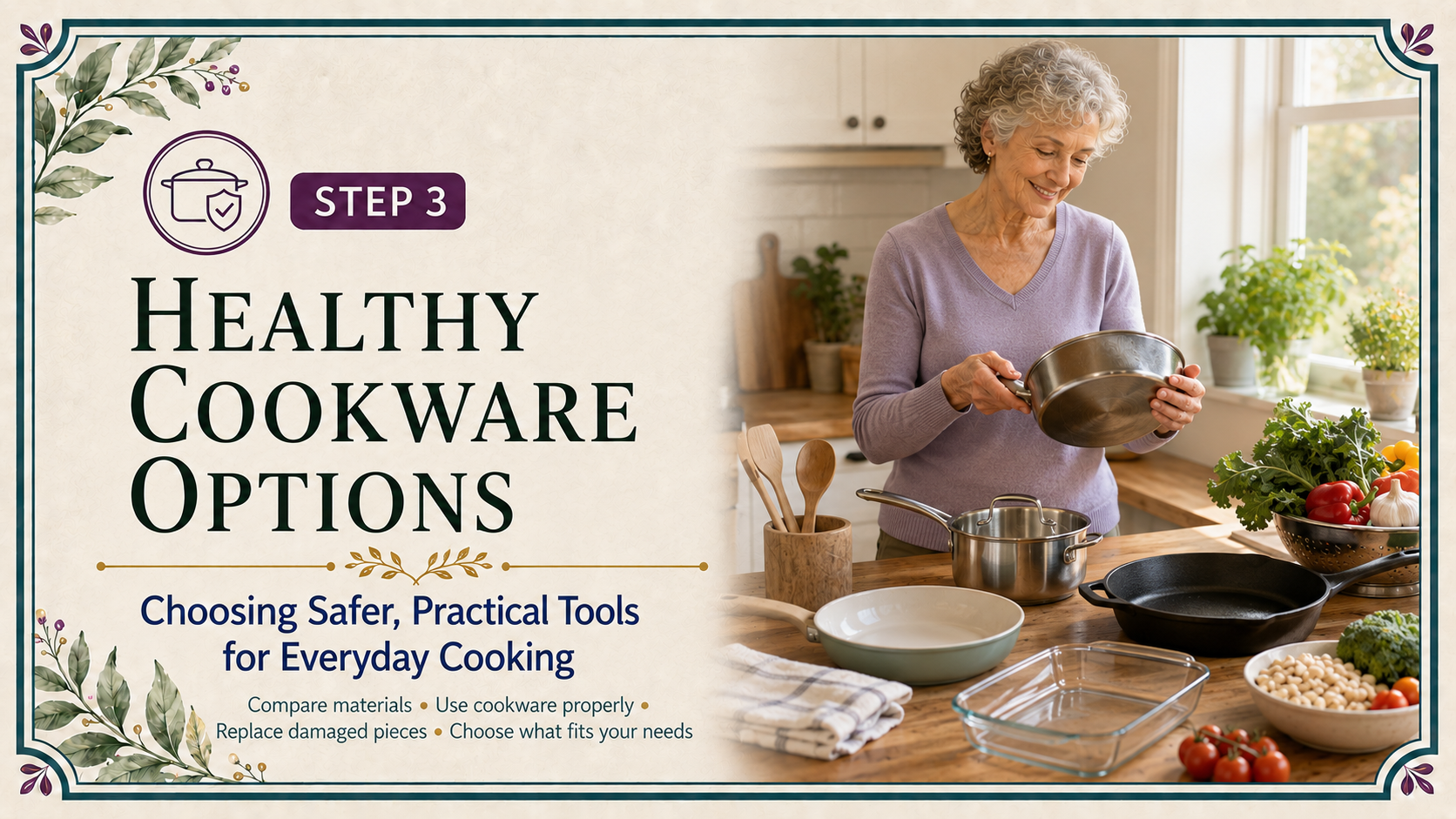
Healthy Cookware Options
What’s Safe, What to Avoid, and How to Cook with Confidence
Why Cookware Matters
Your cookware isn’t just a kitchen tool — it’s part of your health environment. The materials you cook with can affect:
- Nutrient retention
- Chemical exposure
- Taste and texture
- Long-term wellness
Let’s explore the safest options, the ones to avoid, and how to choose what’s right for your home.
Healthier Cookware Choices
1. Stainless Steel
- Pros: Durable, non-reactive, easy to clean
- Cons: May leach nickel if scratched; not ideal for those with nickel allergies
- Best Use: Sautéing, boiling, steaming
2. Cast Iron
- Pros: Naturally non-stick, adds iron to food, lasts generations
- Cons: Heavy; iron can build up in the body with overuse
- Best Use: High-heat cooking, searing, baking
3. Ceramic-Coated
- Pros: Non-stick without Teflon; often free of heavy metals
- Cons: Coating may wear over time; quality varies
- Best Use: Low to medium heat cooking
4. Glass
- Pros: Non-reactive, toxin-free, great for baking
- Cons: Fragile; not suitable for stovetop use
- Best Use: Oven baking, food storage
5. Bamboo & Wood (for utensils and prep)
- Pros: Renewable, non-reactive, gentle on cookware
- Cons: Not for high-heat cooking
- Best Use: Steaming, stirring, serving
6. Terra Cotta / Earthenware
- Pros: Pure clay options are non-toxic and nutrient-friendly
- Cons: Must be unglazed and certified safe; fragile
- Best Use: Slow cooking, steaming, baking
Cookware to Use with Caution
1. Teflon / Non-Stick Coatings
- Concerns: May release toxic fumes at high heat; coating can degrade
- Safer Alternative: Ceramic-coated or seasoned cast iron
2. Aluminum
- Concerns: Can leach into food, especially acidic dishes
- Safer Alternative: Anodized aluminum (less reactive), or switch to stainless
3. Copper
- Concerns: May leach copper and nickel; not ideal for daily use
- Safer Alternative: Copper with stainless steel lining
Tips for Safer Cooking
Tips for Safer Cooking
- Avoid high heat with non-stick pans
- Never use metal utensils on coated surfaces
- Replace scratched or chipped cookware
- Choose brands that disclose materials and safety testing
- Wash gently — harsh abrasives can damage protective layers
Sustainability Matters Too
Healthier cookware isn’t just better for your body — it’s better for the planet. Look for:
- Recyclable materials
- Long-lasting durability
- Minimal packaging
- Ethical sourcing
Printable Cookware Comparison Chart
The chart includes:
Cookware Type | Pros | Cons | Best Uses | Safety Notes |
Stainless Steel | Durable, non-reactive | May leach nickel if scratched | Boiling, sautéing | Avoid harsh abrasives |
Cast Iron | Adds iron, naturally non-stick | Heavy, iron overload risk | Searing, baking | Season regularly |
Ceramic-Coated | Non-stick, toxin-free | Coating wears over time | Low-heat cooking | Replace when scratched |
Glass | Non-reactive, toxin-free | Fragile | Baking, storage | Oven-safe only |
Bamboo/Wood | Renewable, gentle | Not heat-resistant | Utensils, steaming | Hand wash only |
Terra Cotta | Pure clay, nutrient-friendly | Fragile, must be unglazed | Slow cooking | Verify safety certification |
Teflon | Easy release | Toxic fumes at high heat | Low-heat cooking | Discard if scratched |
Aluminum | Lightweight, cheap | Leaches into food | Boiling | Use anodized version |
Copper | Excellent heat control | Leaches metals | Specialty cooking | Use lined with stainless |
Conclusion
Choosing healthier cookware is one of those small but meaningful steps that can make a real difference in your long‑term well‑being. When you understand how different materials behave — what’s safe, what to use with care, and what to avoid — you gain the confidence to cook in a way that supports your health rather than undermines it. You don’t need a perfect kitchen or a full set of specialty pans. Start with one or two safer options, upgrade gradually, and let your cookware become an ally in the intentional, nourishing life you’re building.
Author’s Note
I created this guide to help you navigate the confusing world of cookware with clarity and confidence. There’s a lot of conflicting information out there, and my goal is always to simplify the essentials so you can make choices that feel both practical and empowering. Your kitchen should support your health, not add unnecessary worry — and understanding your options is the first step. Thank you for taking the time to learn, question, and choose with intention.
— Robert
Share Your Thoughts and Experiences
Comment Invitation
I’d love to hear from you.
What stood out to you in this post? What questions or experiences would you add?
Share your thoughts below — your voice helps others on their journey too.
Reference List
- Environmental Working Group — Cookware Safety Guide
https://www.ewg.org/consumer-guides/healthy-cookware (ewg.org in Bing) - Harvard T.H. Chan School of Public Health — Kitchen Safety & Chemical Exposure
https://www.hsph.harvard.edu/news/hsph-in-the-news/chemical-exposure-in-the-kitchen/ (hsph.harvard.edu in Bing) - National Institutes of Health — Materials & Health Risks in Cookware
https://pubmed.ncbi.nlm.nih.gov/ (pubmed.ncbi.nlm.nih.gov in Bing) (general index; specific cookware studies vary) - Consumer Reports — Best & Worst Cookware Materials
https://www.consumerreports.org/cookware/best-and-worst-cookware-materials-a1160786328/ (consumerreports.org in Bing) - American Academy of Pediatrics — Household Chemical Safety
https://www.healthychildren.org/English/safety-prevention/all-around/Pages/Household-Safety.aspx (healthychildren.org in Bing) - Mayo Clinic — Cookware & Health Considerations (Caffeine/Materials Safety Section)
https://www.mayoclinic.org/healthy-lifestyle (mayoclinic.org in Bing)
Disclaimer
The information provided in this article is for educational and informational purposes only and is not intended as medical, psychological, or professional advice. The content reflects general wellness principles and personal development concepts designed to encourage self-reflection and healthy lifestyle choices.
Individual circumstances vary, and readers should consult qualified healthcare professionals, mental health providers, or other appropriate experts regarding specific concerns or conditions. Never disregard professional advice or delay seeking help because of information contained in this article.
The author and publisher assume no responsibility for actions taken based on the information presented. Your health and well-being are ultimately your responsibility, and any changes to your lifestyle should be made thoughtfully and in consultation with appropriate professionals when necessary