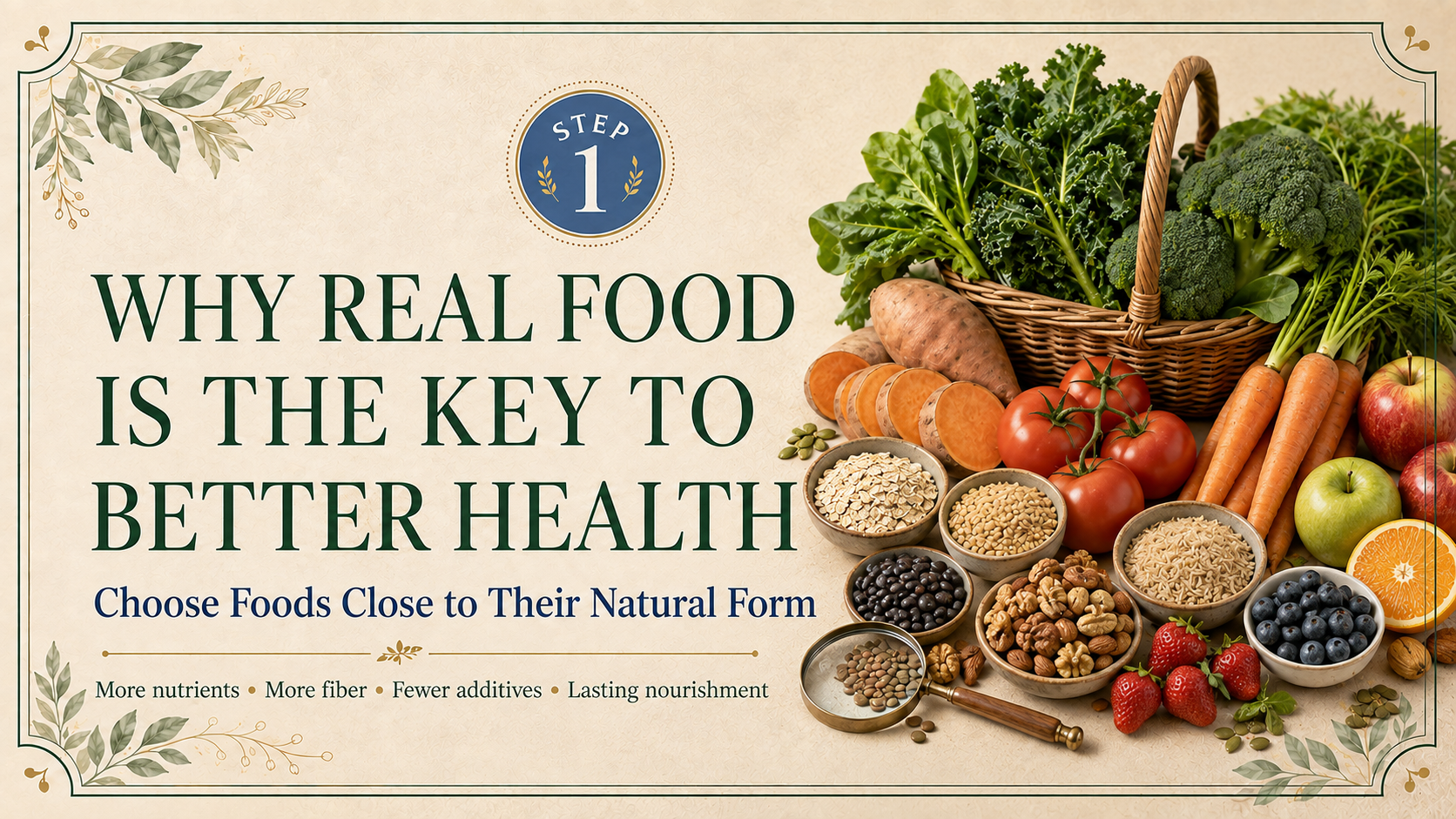
Why Real Food Is the Key
A simple starting point for transforming your health
When you begin your wellness journey, food is one of the easiest and most powerful places to start. Real, whole foods give your body the raw materials it needs to heal, energize, and function at its best. And the good news is: you don’t need complicated rules or restrictive diets to feel the difference.
This pillar is all about helping you understand what to eat — and why it matters.
The Problem Isn’t You — It’s the Modern Food System
Today’s food environment is designed for convenience and profit, not nourishment. Ultra‑processed foods dominate grocery shelves, and they’re engineered to be addictive, long‑lasting, and cheap to produce.
The result?
Your body ends up working overtime to process ingredients it was never designed to handle.
Choosing real food is how you take back control.
What Makes Real Food So Powerful
1. It Works with Your Biology
Whole foods come packaged with the nutrients, fiber, and natural compounds your body understands. They support stable energy, better digestion, and clearer thinking.
2. It Reduces Hidden Stress on Your Body
Ultra‑processed foods often contain additives, refined sugars, and industrial oils that can trigger inflammation and disrupt metabolism. Real food removes that burden.
3. It Supports Long‑Term Wellness
Consistently choosing whole foods helps protect against chronic conditions and supports healthy weight, heart health, and overall vitality.
What “Real Food” Actually Means
You don’t need perfection — just a return to simplicity.
Real food includes:
- Fruits and vegetables
- Whole grains
- Beans and legumes
- Nuts and seeds
- Herbs and spices
- Minimally processed plant‑based staples
If it looks close to how nature made it, you’re on the right track.
Start Small — Start Today
Your wellness journey doesn’t require a dramatic overhaul. Try one or two simple steps:
- Add one extra serving of vegetables
- Swap a packaged snack for fruit or nuts
- Choose whole grains over refined ones
- Cook one more meal at home this week
Small steps create big momentum
Author’s Note
This post is part of the Start Your Wellness Journey series, designed to help readers take simple, empowering steps toward lasting health. It reflects my commitment to clarity, warmth, and evidence-based guidance. I believe real food is one of the most accessible and transformative tools we have — and this article is meant to help you understand why.
---- Robert
Continue The Conservation
Every wellness journey is unique, and we can learn a great deal from one another's experiences.
What stood out to you in this article?
Have you faced similar challenges, discovered helpful strategies, or gained insights of your own?
I invite you to share your thoughts in the comments below. Your experience may encourage someone else who is taking the next step on their own journey.
Remember, meaningful change often begins with a single step—and none of us has to walk the path alone.
Reference List
- Monteiro, C. A., et al. (2019). Ultra-processed foods: what they are and how to identify them. Public Health Nutrition, 22(5), 936–941. https://doi.org/10.1017/S1368980018003762 (doi.org in Bing)
- Harvard T.H. Chan School of Public Health. (n.d.). The Nutrition Source: Whole Grains. https://www.hsph.harvard.edu/nutritionsource/whole-grains/ (hsph.harvard.edu in Bing)
- Mayo Clinic. (2023). Healthy diet: The importance of whole foods. https://www.mayoclinic.org/healthy-lifestyle/nutrition/in-depth/nutrition/art-20046477 (mayoclinic.org in Bing)
- Ludwig, D. S., & Willett, W. C. (2020). Three daily servings of ultra-processed foods may increase risk of chronic disease. JAMA Internal Medicine, 180(6), 830–831. https://doi.org/10.1001/jamainternmed.2020.1035 (doi.org in Bing)
- Academy of Nutrition and Dietetics. (2022). What Is a Whole Food Diet? https://www.eatright.org/food/nutrition/healthy-eating/what-is-a-whole-food-diet (eatright.org in Bing)
- National Institutes of Health. (2021). Processed foods and health risks. https://www.nih.gov/news-events/nih-research-matters/processed-foods-linked-weight-gain (nih.gov in Bing)
Disclaimer
The information provided in this article is for educational and informational purposes only and is not intended as medical, psychological, or professional advice. The content reflects general wellness principles and personal development concepts designed to encourage self-reflection and healthy lifestyle choices.
Individual circumstances vary, and readers should consult qualified healthcare professionals, mental health providers, or other appropriate experts regarding specific concerns or conditions. Never disregard professional advice or delay seeking help because of information contained in this article.
The author and publisher assume no responsibility for actions taken based on the information presented. Your health and well-being are ultimately your responsibility, and any changes to your lifestyle should be made thoughtfully and in consultation with appropriate professionals when necessary.