Introduction
Fats are essential for absorbing vitamins, supporting brain health, and regulating hormones—but not all fats are equal. Prioritizing unsaturated fats from whole foods like nuts, seeds, and avocados can dramatically improve heart health and reduce inflammation. (James-Martin et al., 2024)
Fats have long been misunderstood, but they are vital for your body’s function and long-term wellness. Understanding how different fats affect health is the first step—choosing the right types of fats ensures you nourish rather than harm your body. Let’s take a closer look at what fats truly are.
What are Fats
Fats provide the most energy per gram of any macronutrient, and they serve as an alternative energy source when carbohydrates are unavailable. (Bhupathiraju & Hu, 2025) They play an essential role in brain development, blood clotting, controlling inflammation, cushioning vital organs, providing insulation, and serving as precursors for bile salts and steroid hormones. (Carpenter, 2026) Fats also help absorb fat-soluble vitamins (A, D, E, and K). (Youness et al., 2022) Dietary fats are divided into two primary groups: saturated fats and unsaturated fats.
What Fats Do in the Body
Fats are more than just stored energy. They play critical roles in:
- Absorbing fat-soluble vitamins (A, D, E, K)
- Building cell membranes
- Producing hormones
- Protecting organs
- Supporting brain and nerve function
- Promoting satiety (feeling full after meals)
Each gram of fat provides 9 calories, making it the most calorie-dense macronutrient. (Fat and Calories: The Difference & Recommended Intake, 2019)
Types of Dietary Fats
Fat Type | Sources | Health Impact |
Monounsaturated (MUFA) | Olive oil, avocados, almonds | Heart-protective, anti-inflammatory |
Polyunsaturated (PUFA) | Walnuts, flax seeds, sunflower oil | Supports brain, reduces LDL cholesterol |
Omega-3 (PUFA subtype) | Flax seeds, chia seeds, walnuts | Reduces inflammation, supports heart and brain |
Saturated Fat | Butter, cheese, coconut oil | Raises LDL cholesterol, limit intake |
Trans Fat | Processed snacks, fried foods | Increases heart disease risk, avoid completely |
Why Unsaturated Fats Are the Healthiest Choice
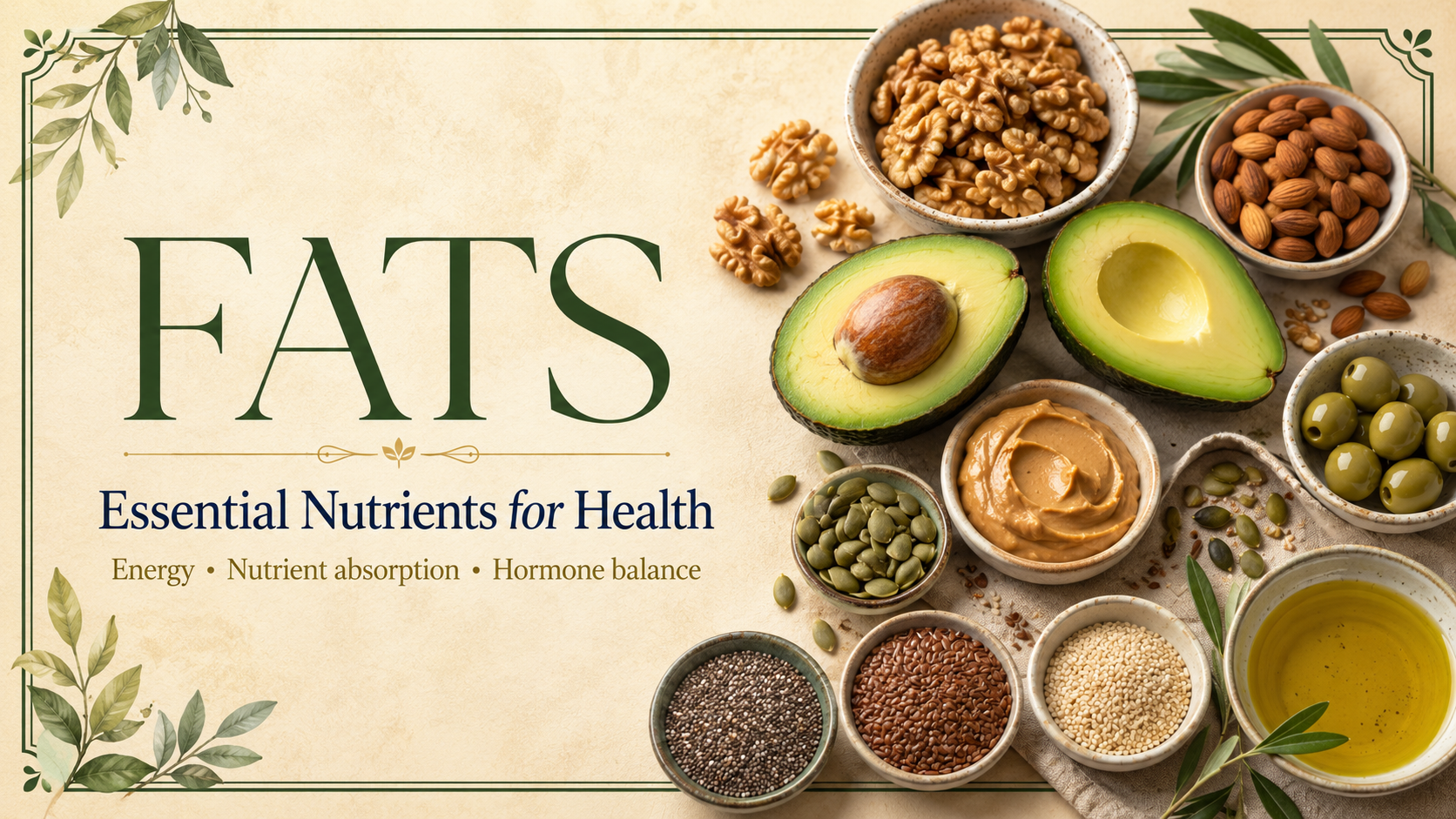
Unsaturated fats are typically liquid at room temperature. In plant-based diets, unsaturated fatty acids are most common. Replacing saturated fats with unsaturated fats can help lower harmful LDL cholesterol. (Astrup et al., 2020, pp. 844-857) Unsaturated fats are mainly found in whole foods such as seeds, nuts, avocados, olives, and oils from grains and seeds. It is important to note that while unsaturated fats are beneficial, plant-based diets often recommend limiting processed oils. For further discussion, see the articles on no more oils and olive oil myths.
Unsaturated fats—especially from whole plant sources—can:
- Lower LDL (“bad”) cholesterol
- Raise HDL (“good”) cholesterol.
- Reduce inflammation
- Improve blood pressure
- Support brain and heart health.
Best sources include:
- Avocados
- Nuts (almonds, walnuts, pecans)
- Seeds (flax, chia, pumpkin)
- Olive oil
- Fatty fish (if included in diet)
Most adults thrive when 20–35% of daily calories come from fat, with an emphasis on unsaturated sources. (Healthy diet, 2023)
Guidelines:
- Monounsaturated fats: Up to 20% of daily calories
- Polyunsaturated fats: 8–15% of daily calories
- Saturated fats: Less than 10% (ideally under 6%)
- Trans fats: Avoid completely (Fats in Foods, 2026)
Saturated Fats
Saturated Fats are solid at room temperature and typically come from animal sources such as dairy products and eggs. (Saturated Fats, 2024) Saturated fats raise LDL (bad) cholesterol levels, and those following a plant-based diet are advised to eliminate them entirely. (Saturated Fats, 2024) Consuming higher levels of saturated fats is associated with an increased risk of heart disease, certain types of cancer, and weight gain that can lead to obesity. (Li et al., 2015, pp. 1538-1548) Examples include butter, cheese, high-fat meats, and milk products. Plant-based diets often recommend avoiding dairy products, including dairy milk.
Start Your Journey to Health
Science confirms that a diet rich in whole, plant-based foods can help you live to the fullest. (Walker, 2024, p. 248) In fact, a growing number of physicians advocate a completely plant-based diet for many of their patients who suffer from diabetes, heart disease, and cancer. (Landry & Ward, 2024) Four great resources:
Plant-Based Nutrition, 2E (Idiot’s Guides) and
Nutrition Facts: The Truth About Food and
The Forks Over Knives Plan and
Join the Physicians Committee’s 21-Day Vegan Kickstart to receive meal plans, recipes, and advice from nutrition experts. This service is free and will help you take control of your health with a vegan diet.
Conclusion / Final Thought
Fats are not the enemy—they are essential partners in your body’s ability to thrive. From fueling your cells to supporting hormone production and helping you absorb key vitamins, healthy fats play a central role in lasting vitality. When you choose whole-food sources like nuts, seeds, avocados, olives, and fatty fish, you help your body function at its best. Small, intentional shifts—such as replacing processed oils with more stable options or balancing your omega-3 and omega-6 intake—can lead to meaningful improvements in energy, mood, and health. (Joshi et al., 2022, pp. 498-509) Let this be an invitation to approach fats with confidence and nourish your body with understanding and respect.
Author's Note
Nutrition is one of the most powerful tools for shaping your long-term health, and understanding fats is a key part of that journey. For years, many were taught to fear dietary fat, but science now reveals an empowering story: the right fats support energy, hormones, brain health, and emotional balance. My aim with this article—and with the entire Essential Nutrients series—is to help you view food as a source of deep nourishment when you understand how it works. I hope this guide offers clarity, confidence, and renewed possibility as you make choices that support your well-being from the inside out.
---- Robert
Continue The Conversation
Every wellness journey is unique, and we can learn a great deal from one another's experiences.
What stood out to you in this article?
Have you faced similar challenges, discovered helpful strategies, or gained insights of your own?
I invite you to share your thoughts in the comments below. Your experience may encourage someone else who is taking the next step on their own journey.
Remember, meaningful change often begins with a single step—and none of us has to walk the path alone.
Reference List
- U.S. Department of Health and Human Services and U.S. Department of Agriculture. Dietary Guidelines for Americans, 2020–2025.
- Harvard T.H. Chan School of Public Health. “Types of Fat.”
- National Institutes of Health, Office of Dietary Supplements. “Omega‑3 Fatty Acids Fact Sheet.”
- Mozaffarian, D., & Ludwig, D. S. (2015). “The 2015 US Dietary Guidelines: Lifting the Ban on Total Dietary Fat.” JAMA.
- Schwab, U. et al. (2014). “Dietary Fats and Cardiovascular Disease: A Review.” Annals of Medicine.
- Simopoulos, A. P. (2016). “An Increase in the Omega‑6/Omega‑3 Fatty Acid Ratio Increases the Risk for Obesity.” Nutrients.
- Calder, P. C. (2015). “Functional Roles of Fatty Acids and Their Effects on Human Health.” Journal of Parenteral and Enteral Nutrition.
- Willett, W. C., & Stampfer, M. J. (2013). “Current Evidence on Healthy Eating.” Annual Review of Public Health.
James-Martin, G., Brooker, P. G., Hendrie, G. A. & Stonehouse, W. (2024). Avocado Consumption and Cardiometabolic Health: A Systematic Review and Meta-Analysis. J Acad Nutr Diet. 2024 Feb;124(2):233-248.e4. https://doi.org/10.1016/j.jand.2022.12.008
Bhupathiraju, S. N. & Hu, F. (2025). Carbohydrates, Proteins, and Fats. Merck Manual Consumer Version. https://www.merckmanuals.com/en-ca/home/disorders-of-nutrition/overview-of-nutrition/carbohydrates-proteins-and-fats
Carpenter, K. (2026). Human nutrition - Lipids, Fats, Cholesterol. Britannica. https://www.britannica.com/science/human-nutrition/Lipids
Youness, R. A., Dawoud, A., ElTahtawy, O., & Farag, M. A. (2022). Fat-soluble vitamins: updated review of their role and orchestration in human nutrition throughout the life cycle with sex differences. Nutrition & Metabolism 19. https://doi.org/10.1186/s12986-022-00696-y
(2019). Fat and Calories: The Difference & Recommended Intake. Cleveland Clinic. https://dev.mycc.clevelandclinic.org/health/articles/4182-fat-and-calories
Astrup, A., Magkos, F., Bier, D. M., Brenna, J. T., Otto, M. C., Hill, J. O., King, J. C., Mente, A., Ordovas, J. M., Volek, J. S., Yusuf, S., & Krauss, R. M. (2020). Saturated Fats and Health: A Reassessment and Proposal for Food-Based Recommendations: JACC State-of-the-Art Review. Journal of the American College of Cardiology 76(7), pp. 844-857. https://doi.org/10.1016/j.jacc.2020.05.077
(2023). Healthy diet. World Health Organization. https://www.who.int/news-room/fact-sheets/detail/healthy-diet
(2026). Fats in Foods. American Heart Association. https://www.heart.org/en/healthy-living/healthy-eating/eat-smart/fats/monounsaturated-fats
(2024). Saturated Fats. American Heart Association. https://www.heart.org/en/healthy-living/healthy-eating/eat-smart/fats/saturated-fats
Li, Y., Hruby, A., Bernstein, A. M., Ley, S. H., Wang, D. D., Chiuve, S. E., Sampson, L., Rexrode, K. M., Rimm, E. B., Willett, W. C., & Hu, F. B. (2015). Saturated Fats Compared With Unsaturated Fats and Sources of Carbohydrates in Relation to Risk of Coronary Heart Disease: A Prospective Cohort Study. Journal of the American College of Cardiology 66(14), pp. 1538-1548. https://doi.org/10.1016/j.jacc.2015.06.140
Walker, J. (2024). Plant-Based Diets: Benefits, Challenges, and Nutritional Considerations. Journal of Nutrition and Dietetics 7(4), p. 248. https://doi.org/10.4172/2472-1921.1000248
Landry, M. J. & Ward, C. P. (2024). Health Benefits of a Plant-Based Dietary Pattern and Implementation in Healthcare and Clinical Practice. Journal of Clinical Medicine 18(5). https://doi.org/10.1177/15598276241237766
Joshi, A., Hegde, M. & Zanwar, A. (2022). Flaxseed oil and palm olein blend to improve the omega-6: omega-3 ratio. Journal of Food Science and Technology 59(2), pp. 498-509. https://doi.org/10.1007/s13197-021-05033-4
Disclaimer
The information provided in this article is for educational and informational purposes only and is not intended as medical, psychological, or professional advice. The content reflects general wellness principles and personal development concepts designed to encourage self-reflection and healthy lifestyle choices.
Individual circumstances vary, and readers should consult qualified healthcare professionals, mental health providers, or other appropriate experts regarding specific concerns or conditions. Never disregard professional advice or delay seeking help because of information contained in this article.
The author and publisher assume no responsibility for actions taken based on the information presented. Your health and well-being are ultimately your responsibility, and any changes to your lifestyle should be made thoughtfully and in consultation with appropriate professionals when necessary.