
Introduction: It’s Not Just About Willpower
A compassionate look at the cultural, emotional, and commercial pressures that make change difficult.
If you’ve ever tried to cut back on meat — or even just thought about it — you may have felt resistance, cravings, or a sense that something was “missing.” Many people assume this is a personal failing or a lack of discipline.
But the real forces behind our eating habits are more complex and freeing than simple willpower. Recognizing this changes everything.
It’s not your fault.
There are powerful forces all around us shaping what we crave, what we celebrate, and what we believe is “normal” to eat. These forces are subtle, emotional, and deeply woven into our culture.
Understanding them doesn’t just help you make healthier choices.
It helps you let go of the guilt and see the bigger picture.
1. The Cultural Story: Meat as Identity, Strength, and Celebration
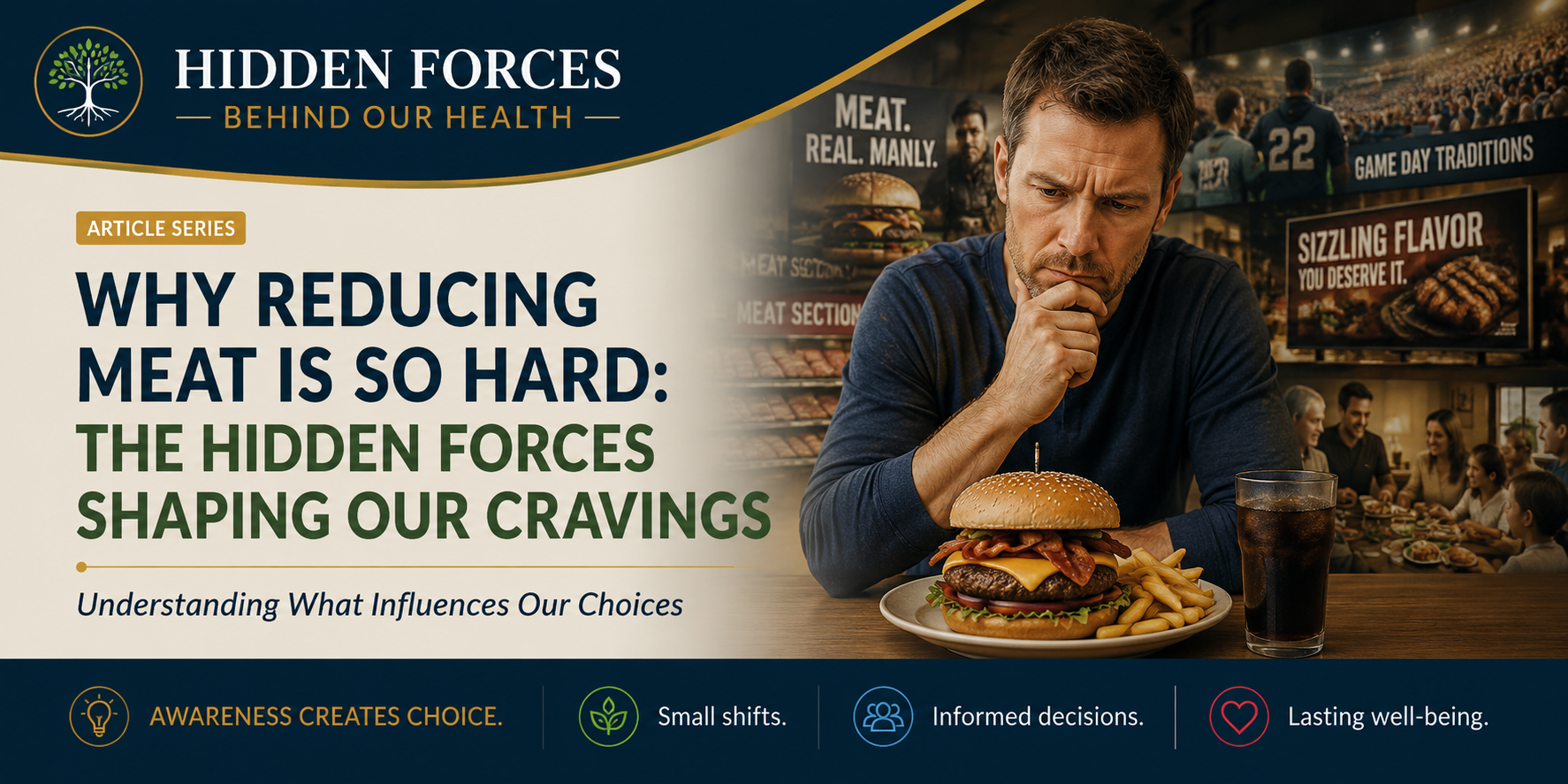
For generations, meat has been marketed as:
- A symbol of strength
- A sign of success
- A reward after hard work
- The centerpiece of holidays and family gatherings
- A marker of masculinity (“real men eat meat”)
These messages aren’t accidental — they’re crafted, repeated, and reinforced through advertising, movies, sports culture, and tradition. (Turnwald et al., 2021)
When something becomes part of identity, changing it feels emotional, not just nutritional.
2. The Marketing Machine: Billions Spent to Shape Your Cravings
The meat and fast‑food industries spend billions every year to make wings, burgers, bacon, and steaks feel irresistible. (Bragg et al., 2025)
They use:
- Emotional storytelling
- Nostalgia
- Humor
- Celebrity endorsements
- Sports sponsorships
- Limited‑time offers
- Visual cues designed to trigger cravings
These ads aren’t just selling food.
They’re selling belonging, excitement, and comfort.
When you see a commercial for wings during a big game, it’s not an accident — it’s strategy.
3. The Sports Connection: Game Day = Meat Day
Sports culture is one of the strongest reinforcers of meat-heavy eating. (Tsai et al., 2022)
Think about the messages we see:
- Wings for the big game
- Burgers at tailgates
- Bacon-loaded breakfast sandwiches during pregame shows
- Beer + meat = celebration
- Ads telling us to “fuel up” with high‑fat, high‑salt foods
These foods become part of the ritual.
Part of the excitement.
Part of the identity of being a fan.
When something is tied to joy, community, and tradition, it becomes incredibly hard to change.
4. The Food Industry’s Secret Weapon: Hyper‑Palatable Foods
Many meat-based products — wings, bacon, burgers, sausages — are engineered to be:
- Salty
- Fatty
- Sweet
- Smoky
- Crunchy
- Addictive
This combination lights up the brain’s reward system.
It’s not about hunger — it’s about chemistry.
Your brain remembers the pleasure and asks for more.
This isn’t a lack of willpower.
It’s biology responding to engineered stimuli. (Lustig, 2020)
5. The Emotional Layer: Comfort, Nostalgia, and Family Traditions
Food is never just food.
It’s:
- Childhood memories
- Family recipes
- Holiday traditions
- Comfort during stress
- A way to connect with others
If meat was part of your upbringing, changing your diet can feel like losing a piece of your story.
That’s why compassion matters.
You’re not just changing what’s on your plate — you’re navigating emotions, memories, and identity.
6. The Good News: Awareness Creates Freedom
Once you understand these hidden forces, something powerful happens: you stop blaming yourself and thinking change is impossible.
You begin to see the system for what it is — a set of influences designed to shape your choices.
With awareness comes freedom: freedom to choose, experiment, and nourish your body on your terms.
Freedom to choose differently.
Freedom to experiment.
Freedom to nourish your body on your own terms.
Why This Matters
Reducing meat isn’t just a nutritional shift.
It’s a cultural, emotional, and psychological experience.
When you understand the forces at play, you can approach change with:
- More compassion
- More clarity
- More confidence
- More patience
You’re not in an inner struggle; you’re responding to a world deliberately designed to influence your eating decisions.
And you’re doing it with intention.
A Gentle First Step
This week, choose one specific moment when you’d normally eat meat—maybe lunch, a snack, or a quiet dinner. Instead, intentionally prepare a plant-centered meal at that time. If you’re unsure where to start, pick a favorite dish and look up a simple plant-based version. Give yourself permission to try just once.
Notice how it feels.
Notice what comes up.
Notice the freedom in choosing for yourself.
Small steps create big change.
Conclusion
If it feels harder than expected to cut back on meat, there’s a good reason. Powerful cultural, emotional, and industry forces shape our cravings and habits. Once you understand these forces, the challenge becomes less personal and much easier to navigate.
Awareness creates space for choice. When you understand why certain foods feel comforting, familiar, or “necessary,” you can start making decisions that align with your health, your values, and the life you want to build. Small shifts count. A few plant‑forward meals each week, a new recipe you enjoy, or simply noticing your patterns with more compassion — these steps add up.
Reducing meat is not about denial—it’s about taking charge of your choices in a food system built to sway you. With awareness and intention, you can create a way of eating that nourishes and empowers you.
Author Notes
This post is part of the Nourish Your Body pillar and pairs with “You Don’t Need Meat to Nourish Your Body.” While post #1 focuses on the science, this post explores the cultural and emotional forces that shape our choices. The goal is to offer compassion, clarity, and empowerment — never judgment.
---- Robert
Share Your Thoughts and Experiences
I’d love to hear what resonated with you. If this post sparked a question, a memory, or a moment of clarity, please share it below in the comments. Take a moment to write your thoughts or experiences—your reflection might inspire or support someone else. Join the conversation and help our community grow.
Reference List
Turnwald, B. P., Handley-Miner, I. J., Samuels, N. A., Markus, H. R., & Crum, A. J. (2021). Nutritional Analysis of Foods and Beverages Depicted in Top-Grossing US Movies, 1994-2018. JAMA Internal Medicine 181(1). https://doi.org/10.1001/jamainternmed.2020.5421
Bragg, M. A., Albert, S. L., Cassidy, O. L., Powell, L. M., & Rummo, P. E. (2025). National Trends in Social Media Food Marketing Expenditures: 2020-2021. AJPM Focus 5(1). https://doi.org/10.1016/j.focus.2025.100440
Tsai, Y., Mochon, D., Ratchford, M. & Girju, M. (2022). When Sports Drive Snacks: A Natural Experiment on Situational Consumption Triggers. SSRN. https://doi.org/10.2139/ssrn.4171310
Lustig, R. H. (2020). Ultraprocessed Food: Addictive, Toxic, and Ready for Regulation. Nutrients 12(11). https://doi.org/10.3390/nu12113401
(2026). The addicted brain: How processed foods hijack reward pathways. Pharmacology Research 2026. https://doi.org/10.1016/j.phrs.2026.108097
Disclaimer
his article is for educational and informational purposes only. It is not intended to diagnose, treat, cure, or prevent any disease. The content reflects current research on nutrition, chronic disease, and dietary patterns in the United States, but it should not replace personalized guidance from a qualified healthcare professional.
Everyone’s health situation is unique. If you have medical concerns, dietary restrictions, or chronic conditions, please consult your physician, registered dietitian, or another licensed healthcare provider before making significant changes to your diet or lifestyle.