Introduction
Many individuals today experience fatigue, exhaustion, or a sense of being rundown before midday. This widespread phenomenon reflects a national trend: increasing stress, higher medication use, and declining nutritional status. (Health, United States, 2020-2021, n.d.) The Standard American Diet, which has been consistently associated with chronic disease and poor nutrition, represents only one aspect of a broader public health challenge. (Kris-Etherton et al., 2020)
Health equity, or more precisely its absence, lies at the core of this crisis. Millions are excluded from systems intended to promote health. (Sterling & Bowen, 2019) Disparities in access to nutritious food, safe environments, quality healthcare, and reliable information have produced conditions in which some individuals thrive while others face significant challenges to survival. (Socioeconomic and Cultural Influences on Health – Study Guide, n.d.)
Examining health equity is essential to understanding the widespread experiences of illness, fatigue, and marginalization and to identifying actionable solutions.
What Health Equity Really Means
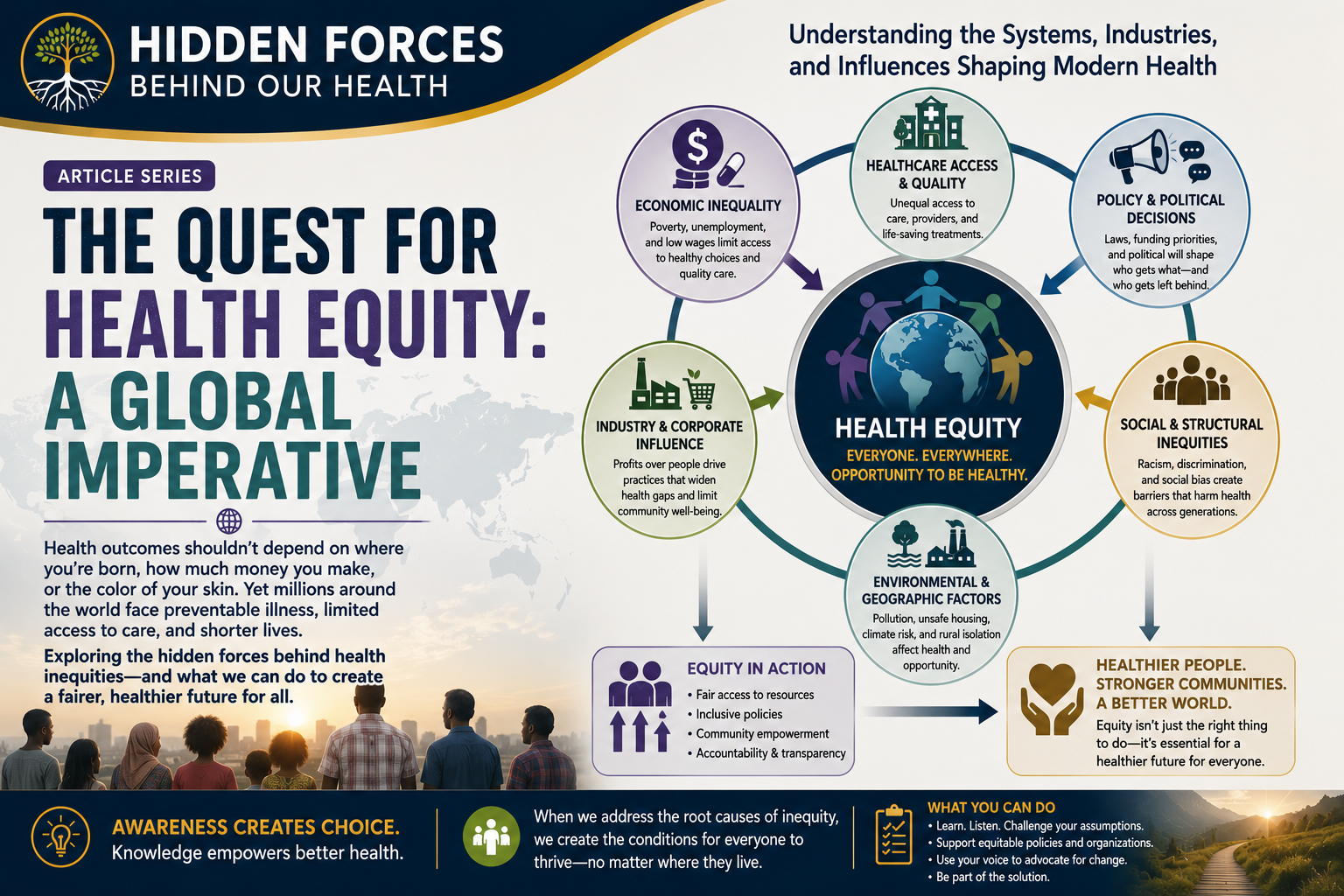
Health equity is the principle of ensuring that all individuals have a fair and just opportunity to achieve optimal health. Rather than providing identical resources to everyone, it focuses on eliminating barriers that hinder healthy living.
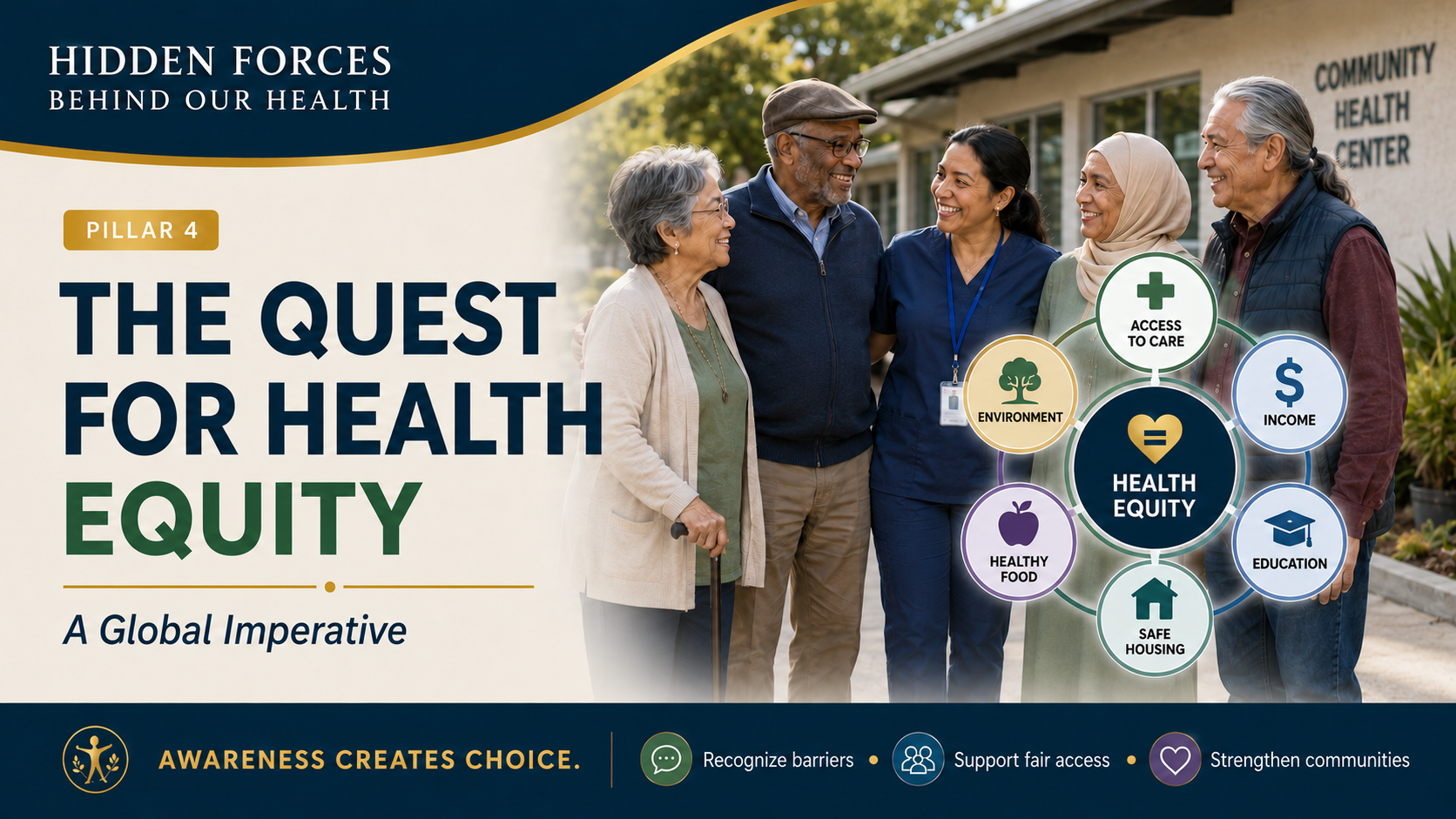
According to the World Health Organization, health equity requires eliminating unfair and avoidable differences in health outcomes. These differences are driven by social determinants such as:
- Income and employment
- Education and literacy
- Access to nutritious food
- Safe housing and neighborhoods
- Transportation
- Social support
- Quality healthcare
When these social determinants are distributed unequally, disparities in health outcomes emerge. This pattern is evident in current public health data. (Social Determinants of Health | heart disease and Stroke Maps | CDC, 2025)
How Health Inequity Shows Up in Real Life
Health disparities arise from persistent structural and social barriers rather than random chance. (Clark et al., 2022) Notable examples include the following:
1. Racial and Ethnic Disparities
Certain populations experience disproportionately high rates of chronic diseases such as hypertension, diabetes, and obesity. (Adult Obesity Facts, 2024) These disparities are linked to inequitable access to healthcare, nutritious food, and safe living environments. (Odoms-Young et al., 2024, pp. 850-861)
2. Socioeconomic Barriers
Individuals with lower incomes often live in health deserts, areas characterized by limited access to fresh food, safe recreational spaces, and affordable healthcare. (Sansom & Hannibal, 2021) These conditions contribute to increased rates of preventable diseases. (Addressing Social Determinants of Health and Chronic Diseases, 2024)
3. Geographic Inequities
Rural communities often lack hospitals, medical specialists, and mental health services, while urban communities may contend with pollution, overcrowding, and inadequate housing. (Rural Health, 2024)
4. Mental Health Gaps
Stigma, financial barriers, and shortages of healthcare providers prevent many individuals from accessing necessary support, thereby exacerbating adverse health outcomes. (Glenn et al., 2024)
5. Environmental Risks
Communities exposed to environmental hazards such as pollution, unsafe water, or poor air quality exhibit higher rates of respiratory and chronic illnesses. (Environments and Contaminants - Criteria Air Pollutants, 2025)
These inequities perpetuate a cycle in which those most in need of support frequently receive the least assistance. (Clark et al., 2022)
Why This Matters: The Human Cost
Exclusion from health systems results in tangible and significant consequences, including:
- Delayed diagnoses
- Higher medical bills
- More chronic disease
- Shorter life expectancy
- Increased stress and mental health struggles
Health inequity constitutes both a public health and a moral issue. Societal progress is hindered when substantial segments of the population are denied access to health care. (Pauly et al., 2021)
A Path Forward: What We Can Control
Although many causes of health inequity are systemic, individuals retain agency, particularly when they are informed about the underlying factors contributing to these disparities.
Improving diet and lifestyle is one of the most accessible steps. Eating nutrient-dense, whole, plant-based foods can dramatically improve health outcomes. This approach is proven to reduce chronic disease and boost energy, mood, and longevity. (Neuenschwander et al., 2023) (To Reap Heart Benefits of a Plant-Based Diet, Avoid Junk Food, 2020)
However, individual efforts are insufficient without broader advocacy for systemic change, including: (Carey & Crammond, 2015)
- Better food access
- Safer communities
- Affordable healthcare
- Education and awareness
- Policies that support wellness for all
Health equity represents both a collective responsibility and a collective opportunity. (Linares-Pérez & López-Arellano, 2008)
Conclusion
The state of health equity in the United States is a significant concern, with observable consequences across all communities. Raising awareness is a critical initial step. By identifying the root causes of inequity and taking action at both the individual and collective levels, we can foster a healthier, more equitable future. (Niederdeppe et al., 2026)
If this message aligns with your perspective, consider sharing it. Collective efforts can help create a world where everyone has equitable opportunities for good health.
Consuming nutrient-rich foods provides substantial health benefits. Modifying dietary and lifestyle habits is an effective yet frequently overlooked strategy. A plant-based, whole-food approach may address numerous health and nutrition challenges. (Landry & Ward, 2024) The adoption of plant-based or vegan diets is a sustained trend, as discussed in Why the Global Rise in Vegan and Plant-Based Eating Isn't a Fad. (Sullivan et al., 2024)
Author's Note
Thank you for taking the time to be with me. My goal in writing about health equity isn’t to overwhelm you with statistics or systems — it’s to help you see the forces that have been shaping your health long before you ever made a single choice. When we understand the bigger picture, we stop blaming ourselves and start recognizing the structural barriers that deserve our attention and our advocacy.
If this message stirred something in you, stay curious. Ask questions. Look deeper. Your health journey is too important to be shaped by systems that were never designed with everyone in mind. You deserve access, clarity, and the freedom to make decisions that truly support your wellbeing.
I'm honored to support your journey as you reclaim your voice and health, one informed step at a time.
— Robert
Continue The Conservation
Reference List
Kris-Etherton, P. M., Petersen, K. S., Velarde, G., Barnard, N. D., Miller, M., Ros, E., O'Keefe, J. H., Sr, K. W., Horn, L. V., Na, M., Shay, C., Douglass, P., Katz, D. L. & Freeman, A. M. (2020). Barriers, Opportunities, and Challenges in Addressing Disparities in Diet-Related Cardiovascular Disease in the United States. Journal of the American Heart Association 9(7). https://doi.org/10.1161/JAHA.119.014433
Sterling, S. R. & Bowen, S. (2019). The Potential for Plant-Based Diets to Promote Health Among Blacks Living in the United States. Nutrients 11(12). https://doi.org/10.3390/nu11122915
(2024). Adult Obesity Facts. Centers for Disease Control and Prevention. https://www.cdc.gov/obesity/adult-obesity-facts/index.html
Sansom, G. & Hannibal, B. (2021). Disparate access to nutritious food: place, race, and equity in the United States. BMC Nutrition 7. https://doi.org/10.1186/s40795-021-00434-2
(2024). Rural Health. Centers for Medicare & Medicaid Services. https://www.cms.gov/priorities/health-equity/rural-health
(2025). Environments and Contaminants - Criteria Air Pollutants. U.S. Environmental Protection Agency. https://www.epa.gov/americaschildrenenvironment/environments-and-contaminants-criteria-air-pollutants
(March 17, 2020). To reap the heart benefits of a Plant-Based Diet, Avoid Junk Food. American College of Cardiology. https://www.acc.org/About-ACC/Press-Releases/2020/03/18/09/26/To-Reap-Heart-Benefits-of-a-Plant-Based-Diet-Avoid-Junk-Food
Sullivan, V. K., Martínez-Steele, E., García-Larsen, V. & Rebholz, C. M. (2024). Trends in Plant-Based Diets among United States Adults, 1999–March 2020. The Journal of Nutrition. https://doi.org/10.1016/j.jnut.2024.07.001
Disclaimer
The information provided in this article is for educational and informational purposes only and is not intended as medical, psychological, or professional advice. The content reflects general wellness principles and personal development concepts designed to encourage self-reflection and healthy lifestyle choices.
Individual circumstances vary, and readers should consult qualified healthcare professionals, mental health providers, or other appropriate experts regarding specific concerns or conditions. Never disregard professional advice or delay seeking help because of information contained in this article.
The author and publisher assume no responsibility for actions taken based on the information presented. Your health and well-being are ultimately your responsibility, and any changes to your lifestyle should be made thoughtfully and in consultation with appropriate professionals when necessary.