Introduction: Creating Confusion Is the Norm
We’re surrounded by health messages every day—but many of them are shaped by industries that profit from our confusion. This post pulls back the curtain on how those forces influence what we believe about food, wellness, and disease, and why reclaiming clarity begins with understanding who’s shaping the story.
The Real Problem: A System Designed to Mislead
Most people think they’re failing at health. But the truth is far more unsettling: the system is failing them — on purpose.
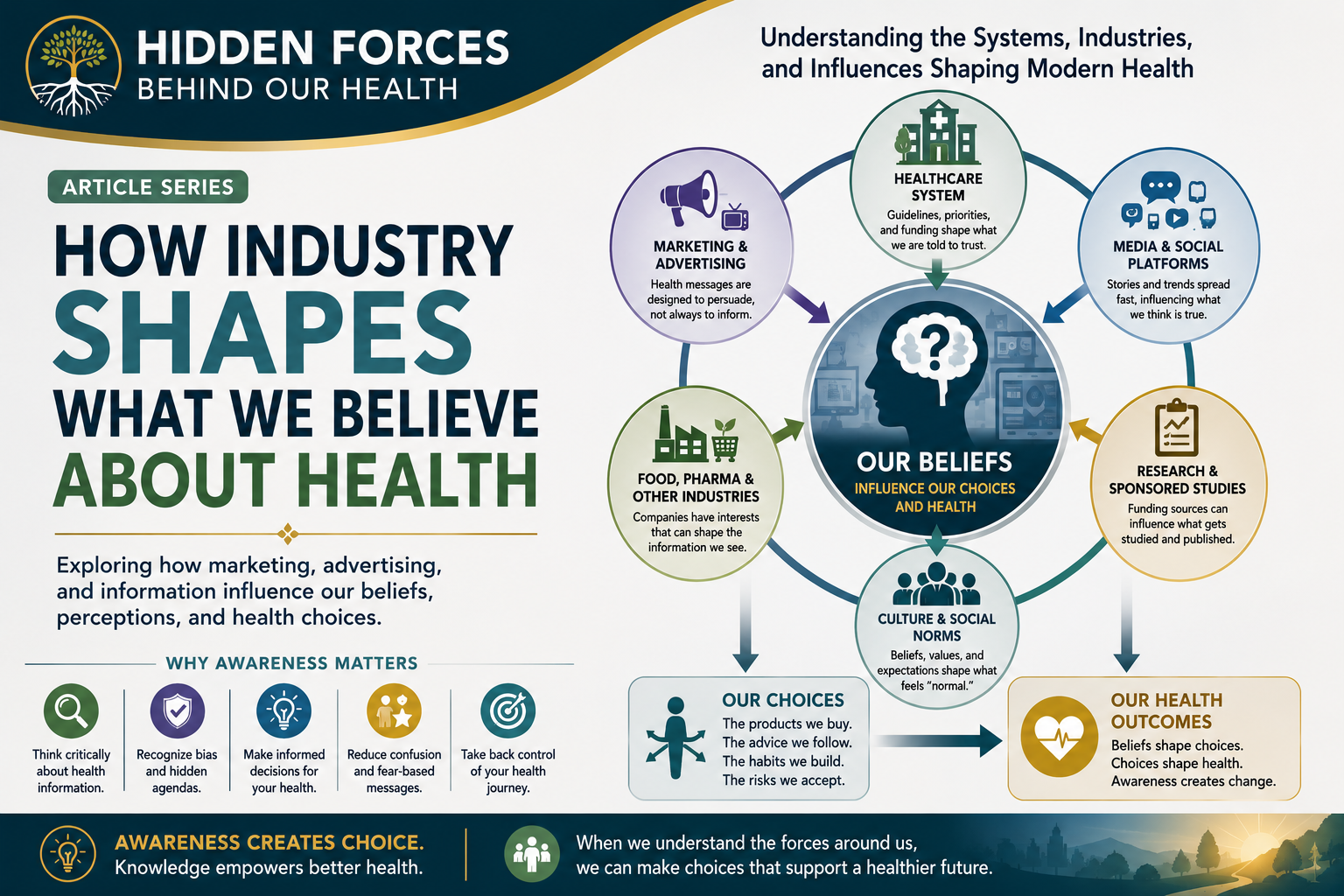
Long before a headline reaches your phone or a doctor gives advice, powerful industries have already shaped the research, the message, and the “truth” we’re allowed to hear. What appears to be “confusion” is actually a carefully engineered outcome.
As Dr. T. Colin Campbell has shown, the modern research pipeline is deeply entangled with corporate interests. And once you see how the system works, everything suddenly makes sense. An article by the Children's Health Defense provides an excellent discussion.
1. Funding: Where the Bias Begins
Research doesn’t start with curiosity — it starts with money.
- Two‑thirds of research funding comes from the NIH. (Budget | National Institutes of Health (NIH), 2024)
- Not one of the 27 NIH institutes is dedicated to nutrition. (List of Institutes and Centers, 2024)
- Fewer than 15% of proposals receive funding. (NIH Research Grants, 2024)
- Corporate-funded studies dominate the field. (Nestle, 2016, pp. 13-14)
When a company funds a study, it wants results that support its products. That means:
- Certain questions get asked.
- Certain outcomes get highlighted.
- Certain findings never see daylight.
Whole-food, plant-based research — which doesn’t produce a profitable product — is often ignored entirely.
2. Publishing: Only a Sliver Reaches the Public
Even when good research is completed, fewer than 1% of studies make it into top journals. (Card & DellaVigna, 2013)
Industry-funded studies have an advantage because they:
- Use reductionist designs that produce “marketable” findings.
- Come with PR budgets.
- Fit neatly into product-driven narratives. (Tanne, 2007)
Meanwhile, studies showing the power of whole dietary patterns struggle to get published because they don’t create a single product to sell.
3. Dissemination: How the Message Gets Distorted
Most published research is never read again. Instead, the media cherry-picks sensational fragments that make good headlines.
This is where industry influence becomes unmistakable:
- Food companies
- Pharmaceutical companies
- Supplement manufacturers
- Segments of the medical industry
All have a stake in shaping public perception.
Even national dietary guidelines are influenced — 95% of committee members have ties to Big Food or Big Pharma. (Conflicts of interest for members of the U.S. 2020 Dietary Guidelines Advisory Committee, 2022, pp. 1-28)
4. The Result: A Public Left Confused
With all this influence, it’s no wonder Americans feel lost.
We’re bombarded with:
- Conflicting nutrition advice
- Miracle diets
- Magic pills
- “Quick fixes”
- Headlines that contradict each other weekly
And the numbers tell the story:
- 42% of our diet comes from animal products
- 51% from oils and refined carbs
- Only 5% from fruits and vegetables (Lin et al., n.d.)
Ninety‑five percent of what we eat is food we were never designed to consume. (Losses, inefficiencies and waste in the global food system, 2017, pp. 190-200)
Doctors, doing their best with the training they receive, often repeat industry-shaped messages. But the system they’re trained in is not designed to make people healthy — it’s designed to generate marketable findings.
5. Why This Matters for Plant‑Based Lifestyle
Whole-food, plant-based nutrition isn’t a trend. It’s a proven path to preventing, halting, and even reversing chronic disease.
But here’s the catch:
- You can’t patent broccoli.
- You can’t trademark beans.
- You can’t build a billion‑dollar campaign around whole grains.
There’s no recurring revenue in telling people to eat real food. And that’s exactly why this message struggles to break through.
Check out these great sources:
- Plant-Based Nutrition, 2E (Idiot’s Guides),
- Nutrition Facts: The Truth About Food and
- The Forks Over Knives Plan
A Final Thought
You’re not confused — you’re being confused. And that’s the part most people never realize. The mixed messages, the sensational headlines, the “breakthrough” studies that contradict last week’s advice — none of it is accidental. It’s the predictable outcome of a system built to shape perception rather than promote health.
But once you see the machinery behind the confusion, something powerful happens. You stop internalizing the blame. You stop thinking you lack willpower or discipline. You stop believing that health is complicated or out of reach. You begin to understand that the real battle isn’t between you and your cravings — it’s between truth and profit.
And that clarity is liberating. It gives you back your agency. It allows you to choose foods that nourish rather than manipulate. It reconnects you with the simple, unprofitable truth: real food heals.
When you step outside the noise, you reclaim your health — not through perfection, but through understanding. And once you see the system clearly, you’re no longer trapped by it. You’re free to choose a different path — one that leads to clarity, energy, and long‑term wellbeing.
Author’s Note
Thank you for taking the time to be with me. My goal isn’t to tell you what to think — it’s to help you see the forces that have been shaping your choices without your consent. Once you recognize those influences, you can begin making decisions that truly serve your health and your future.
If this message resonated with you, stay curious. Keep questioning. Keep learning. You deserve clarity, and you deserve a health journey that isn’t dictated by profit-driven noise.
I’m honored to walk alongside you as you reclaim your wellbeing, one clear and confident step at a time.
— Robert
Continue The Conversation
Every wellness journey is unique, and we can learn a great deal from one another's experiences.
What stood out to you in this article?
Have you faced similar challenges, discovered helpful strategies, or gained insights of your own?
I invite you to share your thoughts in the comments below. Your experience may encourage someone else who is taking the next step on their own journey.
Remember, meaningful change often begins with a single step—and none of us has to walk the path alone.
Reference List
Books & Foundational Works
- Campbell, T. Colin & Campbell, Thomas M. The China Study. BenBella Books, 2005.
- Campbell, T. Colin. Whole: Rethinking the Science of Nutrition. BenBella Books, 2013.
- Greger, Michael. How Not to Die. Flatiron Books, 2015.
- Esselstyn, Caldwell B. Prevent and Reverse Heart Disease. Avery, 2007.
- Hever, Julieanna. Plant‑Based Nutrition (Idiot’s Guides), 2nd Edition. Alpha, 2016.
- Forks Over Knives. The Forks Over Knives Plan. Touchstone, 2014.
Peer‑Reviewed Research & Academic Sources
- Nestle, Marion. “Food Industry Funding of Nutrition Research.” JAMA Internal Medicine, 2016.
- Lesser, Lenard I., et al. “Relationship Between Funding Source and Conclusion Among Nutrition‑Related Scientific Articles.” PLoS Medicine, 2007.
- Mozaffarian, Dariush. “Conflict of Interest and the Food Industry.” Circulation, 2017.
- National Institutes of Health (NIH). Research Funding Statistics and Institute Overviews.
- U.S. Department of Agriculture (USDA). Dietary Guidelines Advisory Committee Membership and Disclosures.
Documentaries & Media
- Forks Over Knives (2011). Directed by Lee Fulkerson.
- What the Health (2017). Directed by Kip Andersen & Keegan Kuhn.
Educational & Evidence‑Based Websites
- NutritionFacts.org — Research summaries and evidence-based nutrition education.
- ForksOverKnives.com — Recipes, research, and lifestyle guidance.
- NIH.gov — Funding data and institute information.
Disclaimer
The information provided in this article is for educational and informational purposes only and is not intended as medical, psychological, or professional advice. The content reflects general wellness principles and personal development concepts designed to encourage self-reflection and healthy lifestyle choices.
Individual circumstances vary, and readers should consult qualified healthcare professionals, mental health providers, or other appropriate experts regarding specific concerns or conditions. Never disregard professional advice or delay seeking help because of information contained in this article.
The author and publisher assume no responsibility for actions taken based on the information presented. Your health and well-being are ultimately your responsibility, and any changes to your lifestyle should be made thoughtfully and in consultation with appropriate professionals when necessary.
